
Strange Times
Functional Music, AI, and a Brief History of Sound of Picture

Hi. I’m Chad. I like to walk, listen and make music. For now it’s my both my practice and my work. This article provides some context and historical contours of my path in music. Thanks for tuning in. I’m glad you’re here!
Two months into 2026 and I’m feeling strange, I have to say. My instincts are telling me to just keep my head down, get some work done, take care of my family and myself… My worries are varied, but for the purposes of this post I’ll confine them to the context of my work, which is to make music. Before I go further, I have a new song to share with you that is perhaps a little bit out of character. It’s called “Doomscroll Timer” by Mello C, a pseudonym I invented in 2020. Feel free to press play. It will become clear should you choose to read on.
My repertoire of the last six years or so could be reasonably called “functional music”, or “mood music”. Both have a dismissive connotation in this era, which I have come to weirdly embrace. This body of work uses my own environmental field recordings in equal measure to my compositions. Lately I’ve been trying on the label “environmental music” when I write the requisite blurbs for promotion. It is not a well-codified genre.1
If I were an influencer, you’d call this formula of environmental recordings + minimal compositions my brand. I prefer calling it my practice. The word practice, I think, is a nice word. It holds within it the notions of both imperfection and intention. Amateurs practice to get better. I’ve always thought of myself as an amateur, even when my tax returns paint me in a professional box.
So, yeah, I’ve been feeling strange: a profound uncertainty seems to have settled in, having more than a little bit to do with the gathering clouds of an AI sea change, or at least the projection of one. Functional music may very well be ground zero for AI-generated music displacement in music streaming. The worldwide audience is large, and the bar is pretty low for AI slop. The bar might realistically be, can you fall asleep to it?
While AI can crank out a relaxing tune, it can’t go on a soundwalk. So, while functional musicians are getting squeezed writ large, my obsession with environmental sound (including the place and date noted on every cover, and discussed in detail here on Substack) is perhaps my competitive advantage. My moat, as they say.
Still I’ve been feeling vulnerable, and I’ve been looking at my options for making ends meet, should my streaming revenue plummet. Prior to going all in on ambient and field recording, I created functional music of a different sort: production music. For a while production music licensing was my bread and butter. Like ambient, it too is seemingly low hanging fruit for AI.
What is production music, you ask? Production music is just another type of functional music. It’s any kind of music that goes into a production: it serves the product. The product could be a film, ballet, podcast, or an ad for a product or service, and so on. I fell into a rhythm of creating instrumental music after setting a goal to anonymously write and share three instrumental songs a week via podcast in 2007. My pen name—with a nod to the then-nascent podcast delivery vehicle—was Podington Bear.
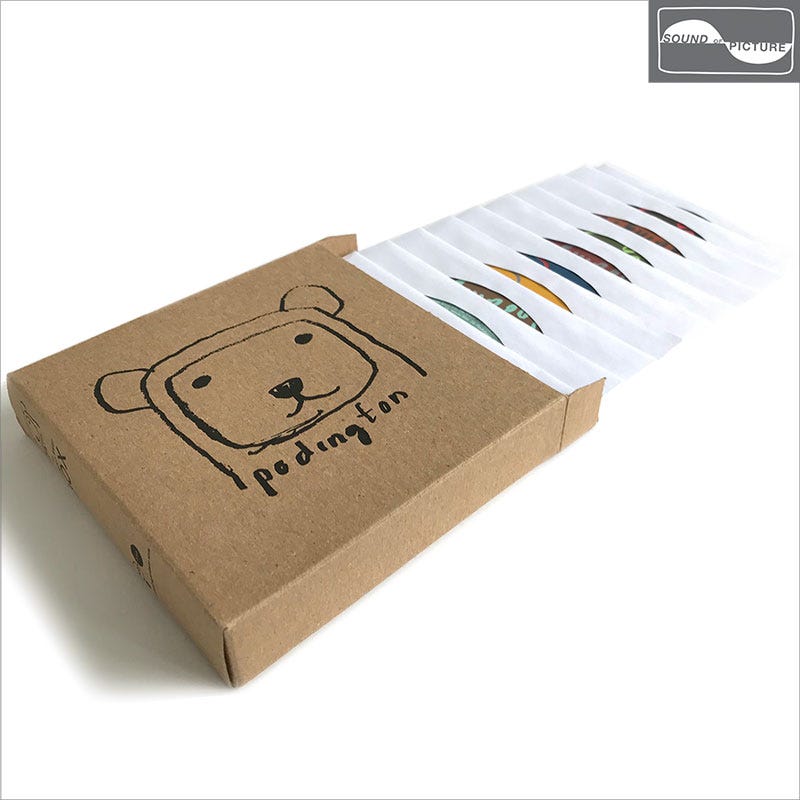
When my Podington Bear songwriting sprint was winding down, I pivoted, starting a new podcast called Sound of Picture. It offered up moody, atmospheric songs, one by one, each paired to a photograph: the sound of the picture. This podcast was short-lived, existing just a few years, with sporadic updating. In 2013, when I built up enough instrumental tracks to set up shop as a one-man boutique music licensing house, I appropriated the under-utilized domain soundofpicture.com that I registered a few years prior for my new music licensing site. Thirteen years later, Sound of Picture is still alive and kicking, with well over 4000 tracks on offer. It is also the name of the label imprint that collects all of my musical works after 2008.
By the mid 2010’s Sound of Picture, and music licensing in general, outperformed other revenue streams generated from wearing various other hats in the music industry. I ran/run a label called HUSH Records (est. 1998); I managed merch fulfillment for The Decemberists for well over a decade; and I helped singer-songwriter Laura Veirs run her own label for most of the 2010’s.
In 2018, I retired from these roles, hung up the name Podington Bear, and discovered the rejuvenating effect of listening to the natural soundscape. Field recording became a way to document this listening practice. Before long, all of my recorded output became a kind of “bottling up” of these listening sessions in nature, accompanied by the instrumental music they inspired. My approach fundamentally changed. I wasn’t thinking this will fill out my licensing library. To the contrary. I just wanted to do it for myself. In that spirit I released the new work under my own name, and didn’t bother to add it to my production library. My discography ballooned, and my streaming income grew while my licensing income waned.
At the beginning of the year I couldn’t shake the feeling that it could all wash away. From its height, Sound of Picture business has fallen precipitously. So, I resolved to put a little elbow grease in to my somewhat neglected music licensing enterprise. I remixed all of the environmental music of the last six or seven years—removing the field recordings—concluding that they would certainly be useful to someone, written as they were to accommodate a layer of sound in the frequency range of the human voice. (Birdsong was the stand-in.) The problem with most music libraries, I think, is that the music is overcooked. Musical scores often work better with stark arrangements. There’s little need for verse-chorus-bridge stuff.

After tripling the track count, I implemented new simplified licenses and an affordable subscription model. Lastly I gave the site a little glow-up. I realized it may all be too little too late, but, I also knew it was now or never.
If you use music in your line of work, pop on over and see if something could be useful. I think I have something to offer that bigger services don’t.
Last month I was inspired to make new music in the vein of dusty pseudonyms I invented over the last decade: Mello C was my experimental beat-making from a park bench moniker of the early 2020s. A. A. Aalto was my power-ballad reservoir of the late 2010’s. I’ll be rolling out all-new offerings from both over the coming months. I’ll probably mention these releases in passing, but Soundwalk will continue to serve up the environmental music you’ve come to expect.
Doomscroll Timer is the first stand-alone 3-track single release filed under Mello C, now available on all streaming platforms.
Looking forward, on one hand I know exactly what’s in store this year: I just uploaded practically my entire 2026 release schedule to my distributor. There will be some surprises. On the other, I have no idea—I really do feel like the music landscape is shifting beneath my feet.
Finally, I think the topic of AI and music deserves its own post, so I didn’t delve into the mechanics and thorny issues here. I do have some thoughts.
As far as I understand, “environmental music” is a literal translation of Kankyō Ongaku (環境音楽) a Japanese phrase coined in the 1960s, following Erik Satie’s 1917 concept of “furniture music” and the pioneering ambient works of Brian Eno, which found a receptive audience in Japan. Eno’s definition of ambient may yet be the most succinct: music “as ignorable as it is interesting”. The same might be said for environmental music.
It is not a tenet of Kankyō Ongaku / environmental music that it should include environmental field recordings, but there is certainly some correlation.
Love this little walk through your history and update on where you're at now. Thanks for sharing. I've gotta say, that Sound of Picture site is gorgeous. I hope that the licensing side picks back up for you. Your music is always so good ( and I love the track you included here. That little sweeping saw thing in the chorus is pretty magical). I also always admire your ability to dip in and out of different styles/genres and come up with (and maintain!) multiple monikers. Can't wait to hear more!
I'm in a place where I'm working on the same wavelength - using field recordings of the spaces I exist in as a way to create music in conversation with the sound of those space. I recently called it 'ambiance music' to emphasize the place-based aspect of it. BUt ya, I'm totally thinking along these same issues right now - regarding the thin line between this artform and endless AI constructions for 'optimizing life'...