

Welcome back to another edition of Sound and Vision. Feel free to click play on the environmental sound below and listen while reading on!
There’s a newspaper clipping from September 28, 1958, from the Oregonian archives. The headline is about opening Forest Park’s primitive boulevard, Leif Erikson Drive, to automobiles for a weekend. I’ve only ever known it as the winding gravel road used only by cyclists, hikers and runners. The idea of driving the road in a car didn’t appeal to me, but tucked into the middle of the article is a paragraph that caught my attention:
Along this stretch of park is found the most primitive woods, including the biggest tree in the city, a Douglas Fir, 29¾ feet in circumference, 8½ feet in diameter, about 200 feet high, despite a broken top. The tree, unofficially called the “Munger Fir,” is not marked in any way as yet.
Not marked in any way as yet. Sixty-seven years later, that “as yet”seemed awaken a yearning in me for a good old fashioned treasure hunt. I decided to see if I could find it.
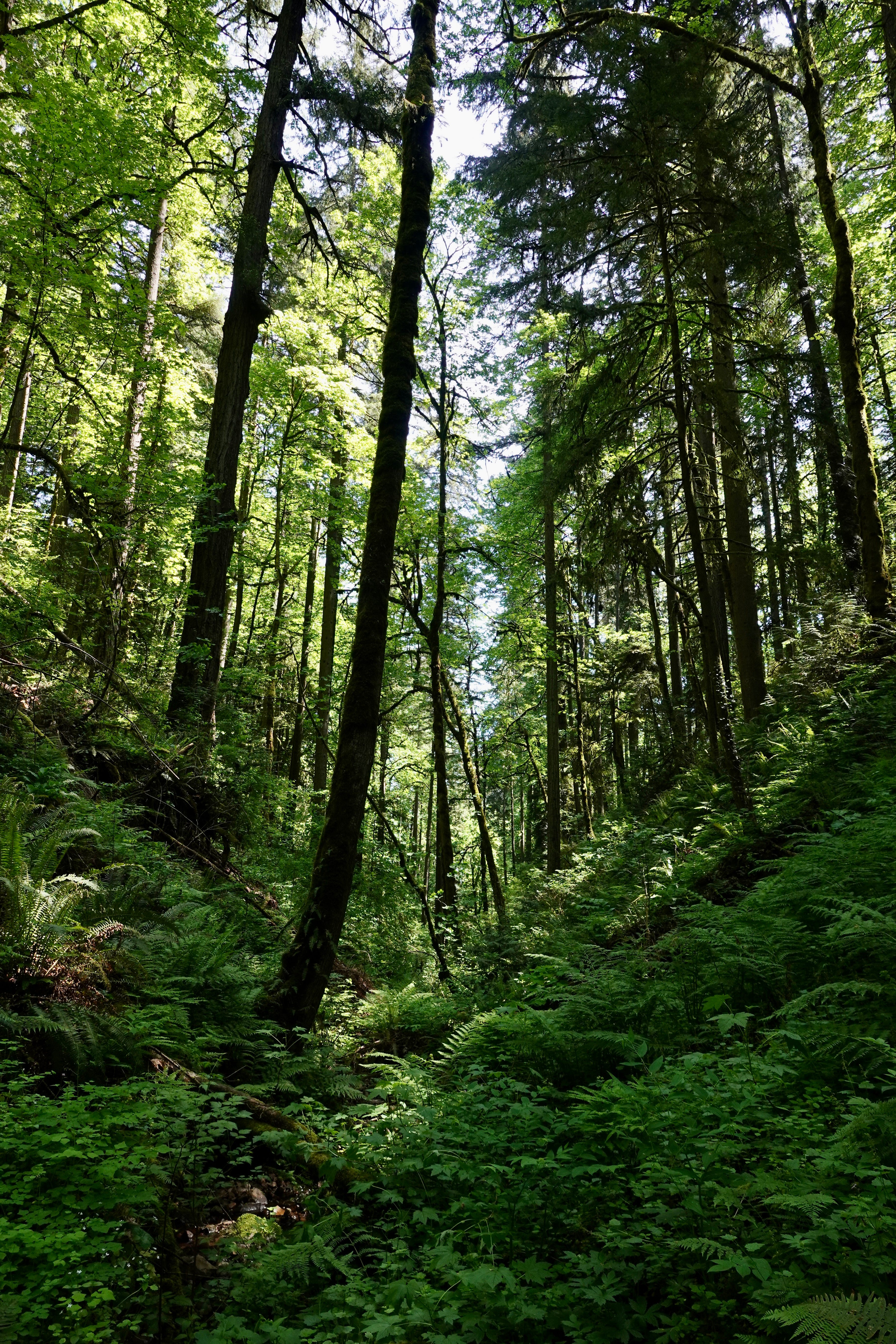
The approach I chose followed a creek watershed. The ferns were thigh-high and the overgrown trail crossed the steep canyon near a downed trunk approaching 5 feet in diameter. Its shattered extremity climbed the opposite side of the canyon. It was clear I was in a neighborhood of tall trees, but I was looking for something unmissable: a trunk the width of a school bus, a column of bark rising into the canopy like a freight elevator shaft.
I found big trees. Several in fact. Enough to tire of craning my neck back. But the Munger Fir, if I passed it, didn’t announce itself. I eventually climbed back up to the old road and walked its length in both directions, scrutinizing every dark shape in the stand. At some point I stopped looking and shrugged it off.
LiDAR
I came home and found the Oregon Tall Trees LiDAR GIS layer instead.
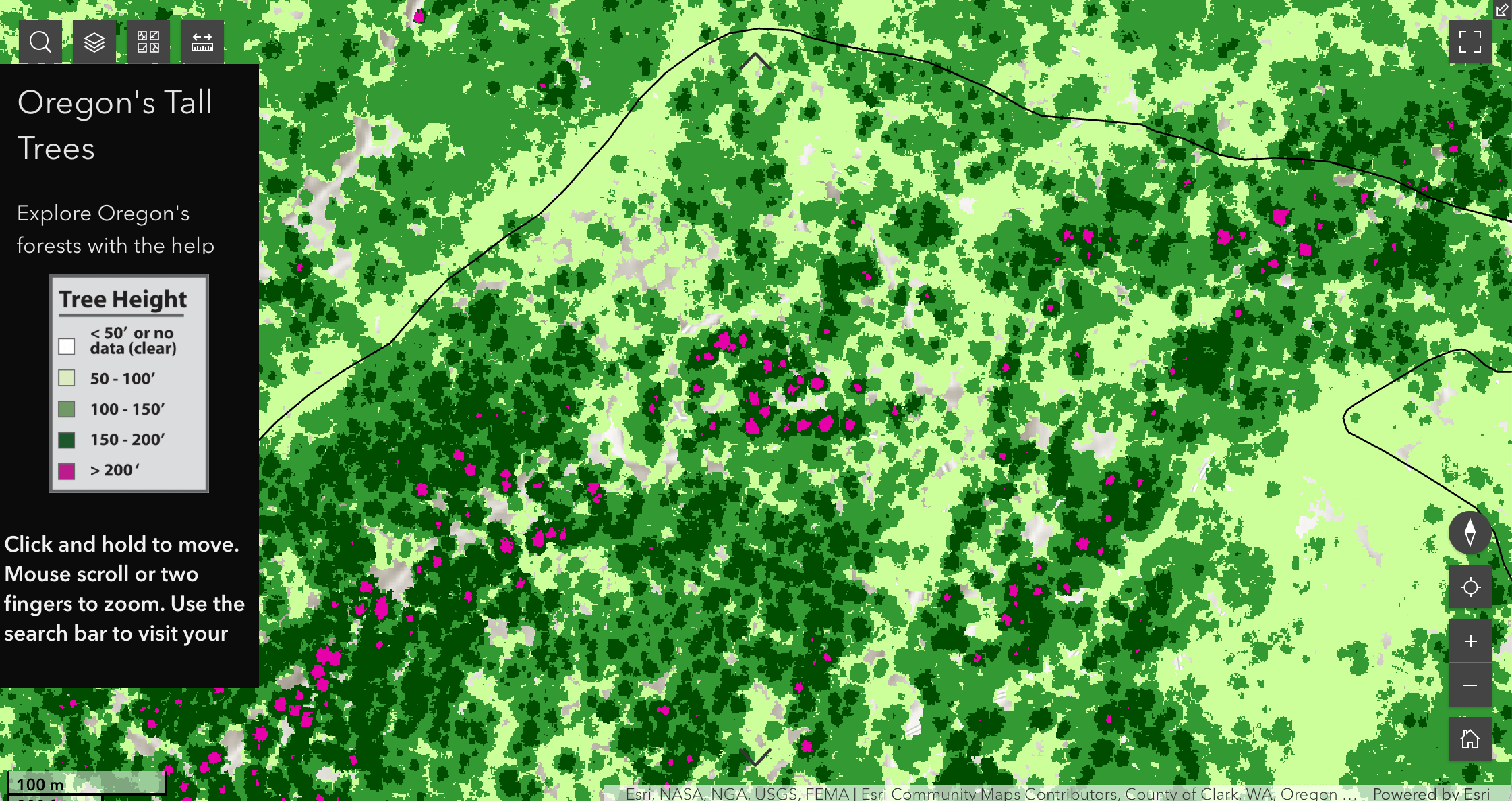
The map renders the forest in shades of green: light green is <100 feet, medium green is 100-150 feet, dark green is 150-200 feet, and magenta is >200 feet, So, each magenta dot marks tree that should be taller than 200 feet, taller than a 20 story building. These measurements are taken by beaming laser light from an airplane over an area and measuring how long it takes the light to bounce back. It’s incredibly precise.
I started counting the dots. One watershed had 94. Across the whole park, working through eight map tiles systematically, the count approached 600. Six hundred Douglas-firs over 200 feet tall, in a city park. Not too shabby!
The tree that made headlines in 1958 for being 200 feet tall despite having a broken top, turns out to be, by this measure, unremarkable. Or rather: remarkable in the way that changes the definition of the word. If 600 trees share the distinction, it’s not a curiosity, but a population.
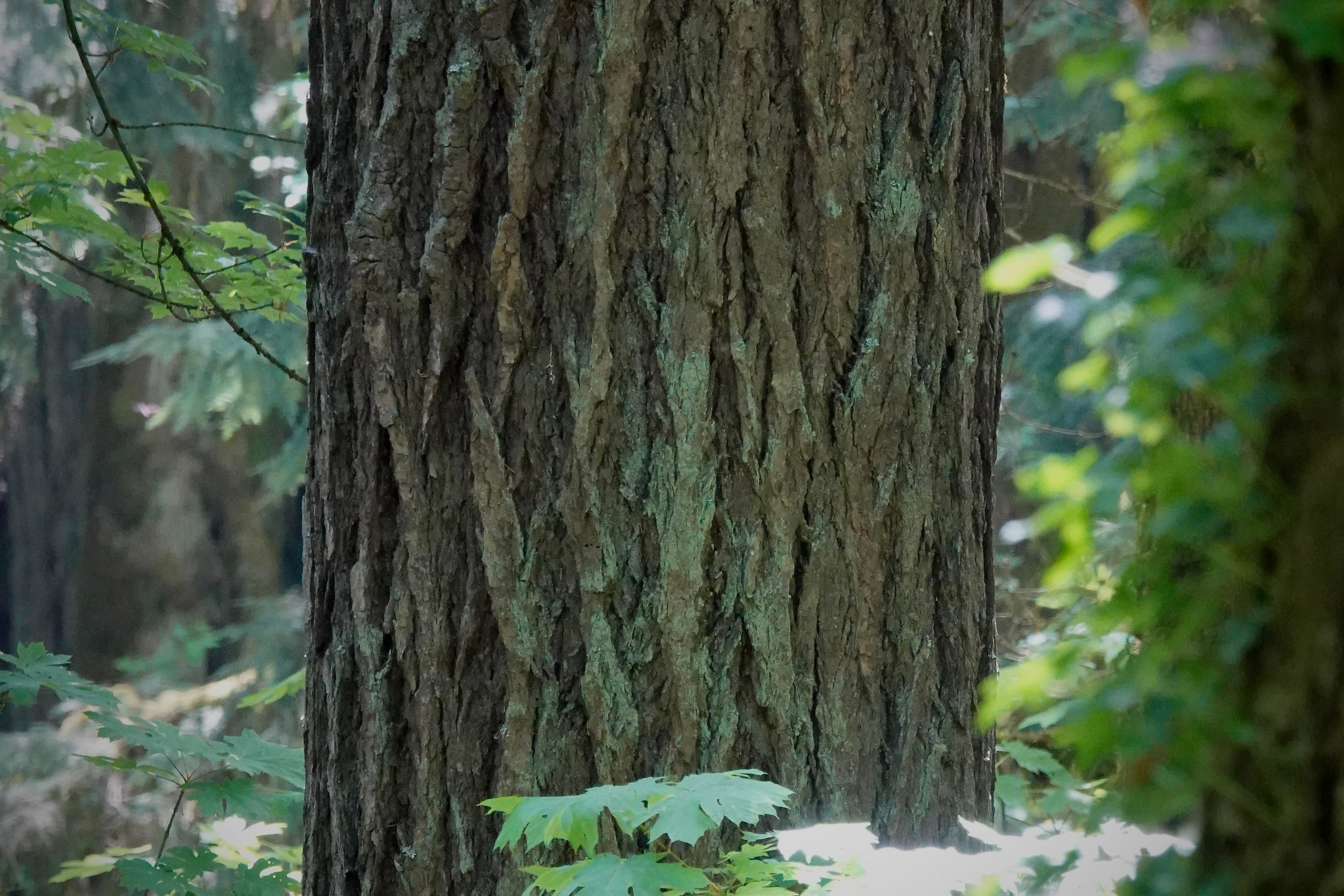
The tallest LiDAR “canopy hit” I found in this watershed was 242 feet, the same height as a Douglas-fir a few miles south of here in Balch Creek Canyon, which was crowned Portland’s tallest in 1997. More recently, another Douglas-fir less than a half mile away from there was measured at 268 feet in 2019, and is quietly holding the title of the tallest tree in Portland today.
After discovering the Oregon Tall Tree website, I had a thirst for more precision, something would output latitude and longitude coordinates. I downloaded QGIS, a free, open source app, which is about as intuitive as learning to fly a helicopter. I then downloaded canopy data from the state’s spatial data library, a hulking dataset, which arrive in formats with inscrutable filenames. Finally, I succeeded in generating a “canopy layer model”, but I never could work out how to make the “Oregon Lambert” coordinate reference points translate to standard Google Earth coordinates, and ultimately gave up.
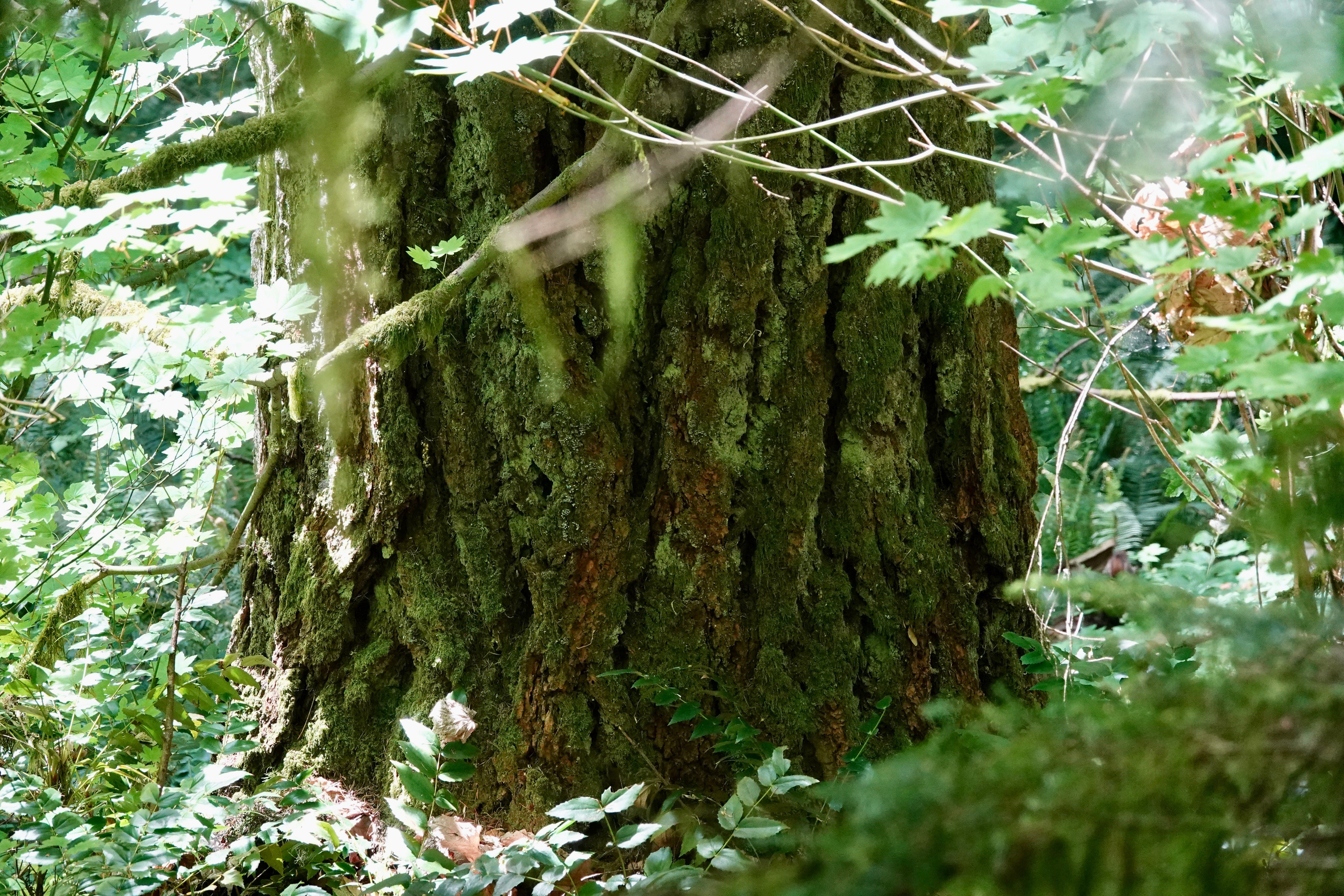
While I was in the weeds of all this, I kept thinking about a book I’d read years ago: The Wild Trees, by Richard Preston. It chronicles the small obsessive community of researchers who climb the coastal redwoods of Northern California in search of the tallest living thing on earth. In 2006 they ultimately find it: a coast redwood they name Hyperion, standing 380 feet tall, in a place so remote and deliberately unspecified that its coordinates remain unpublished. The book reads like a thriller. The trees are the mystery.
What struck me, while clicking through LiDAR pixels, was how much of that story is about the gap between what is known and what is recorded. Hyperion wasn’t the tallest tree on earth until the day someone decided to measure it and tell someone else. The forest doesn’t keep records.
That brings me to the fallen ones.
Historical Titans of the Pacific Northwest
Near a small Washington town called Mineral, a Douglas-fir once stood that was calculated have once reached 393 feet tall. First recorded in 1905, the top had recently broken off. The downed section measured 168 feet, while the standing portion measured 225 feet, for a combined 393 feet height. It was 15.4 feet in diameter at a height of 6 feet. Twenty-five years later, the topped giant fell in a windstorm in the winter of 1930. A cross-section was given to the Wind River Arboretum as a memorial. It’s still there, a little over an hour’s drive away; I could go count the rings right now if I wanted to. The nearby sign tells visitors it was approximately 875 years old, though other sources report 1080 years. It is now officially considered the tallest Douglas-fir reliably recorded in Washington state.


And then there is the Nooksack Giant: measured with a tape after felling at a claimed 465 feet in length, and nearly 11 feet in diameter at the base. These measurements strike many as embellished. Nonetheless, thorough analysis suggests the tree was conceivably towering.
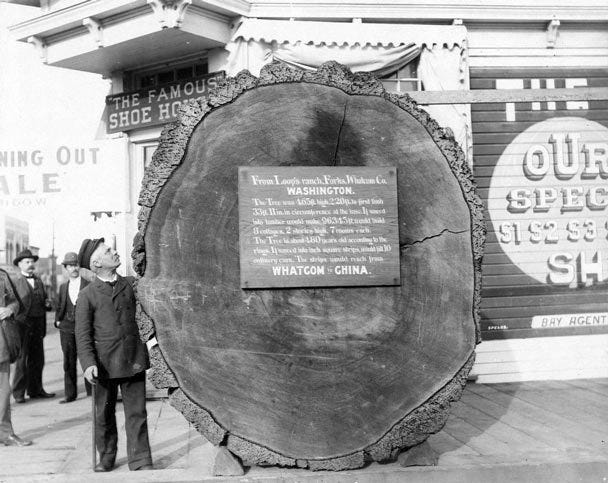
Of course, these trees are now gone. What remains are measurements, newspaper clippings, black and white photos, and a section of a log in an arboretum.
I grew up here in the Pacific Northwest, and took the trees for granted, the way you take gravity for granted. It takes a while to comprehend that a Douglas-fir has a theoretical ceiling somewhere in the 400 foot range; that the species comfortably lived in that range before, and that the trees currently growing in the forests around me are still slowly reaching for those heights again.
The tallest living Douglas-fir is the Doerner Fir in Oregon’s Coast Range, standing 325.8 feet. Remarkable, but well short of what the species once achieved. Hyperion, the champion coast redwood bests it by 55 feet. That substantially taller Douglas-fir, was measured within the last century gives me pause. Is there another one out there, hiding in a remote Siskiyou-Rogue River National Forest canyon? Or in the coastal forests of British Columbia?
A Douglas-fir that is 200 years old today could, in the absence of fire, wind or chainsaw, could till be growing 400 years from now. At that point it would be 600 years old, still four centuries younger than the Mineral Tree when it fell. Our grandchildren’s grandchildren’s grandchildren could conceivably stand at its base and look up at something that was a seedling when Lewis and Clark came through.
The Munger Fir, wherever it stands, if it still stands, is probably not a contender for a superlative tree, but it has had sixty-seven more years to grow since a journalist described it, so it would be interesting to observe how it has changed.
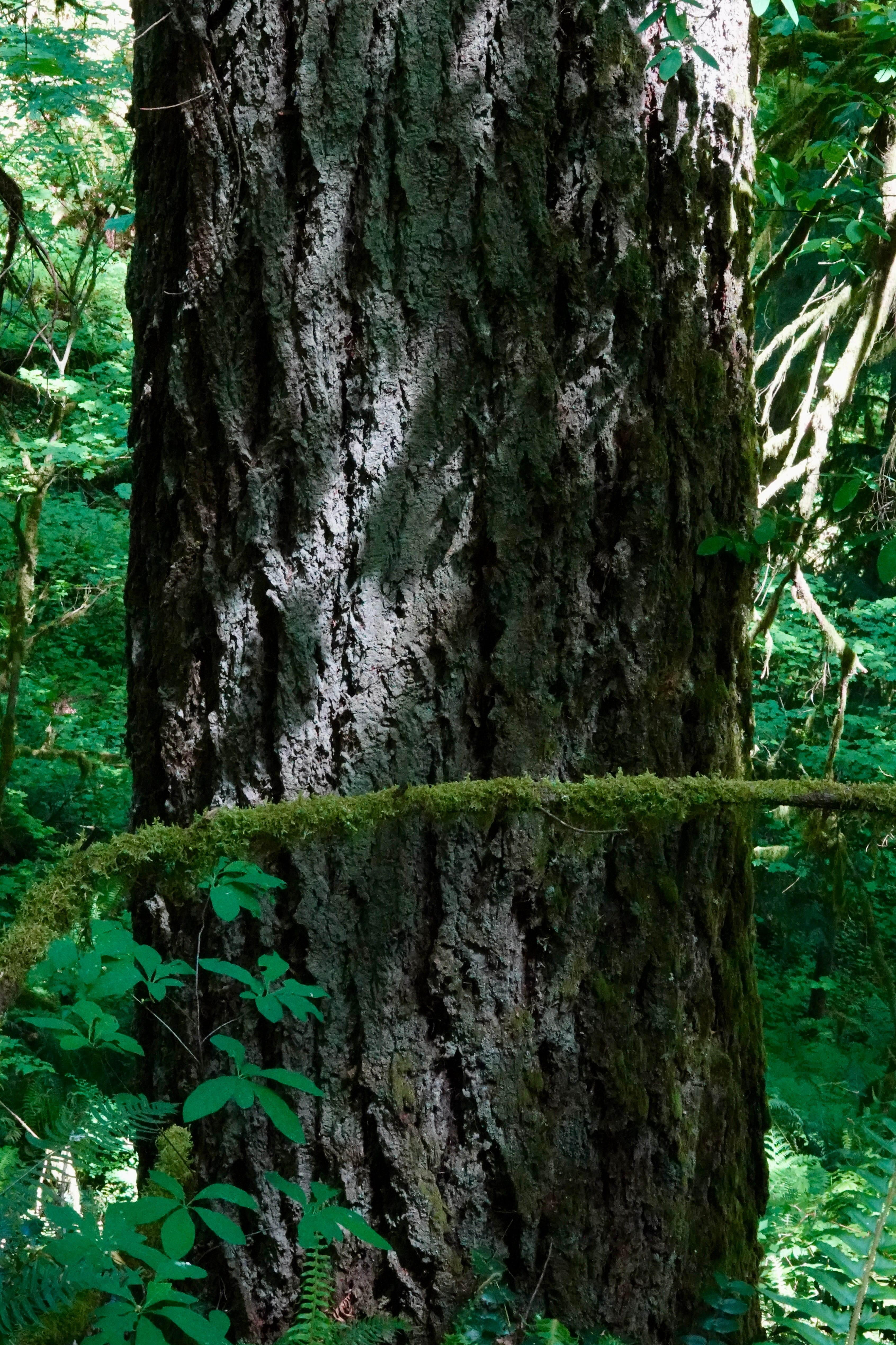
Thornton Munger headed the Committee of Fifty; the civic body that pushed through the legislation, rallied public support, and ultimately gave Portland its great urban forest. A forest Economist by training, he spent decades thinking about what trees meant to a city, to a civilization.
Alas I never located a tree that matched the description of the Munger Fir. After my hunt came up short, I sat with the question, what exactly was I looking for? Was it for that one tree? Was it simply to say, “There it is! I found it!” Or something more like “ There it is; the oldest living thing for miles and miles and miles.” Or…what? Maybe both; maybe to feel some connection I can’t really put words to.
Once More, for Good Measure
A few weeks later made another pass through the area, taking the same route. This time, however, I had an app on my phone called Arboreal Tree, which can take triangulated measurements using GPS, the phone’s camera and accelerometer. I’m not sure how accurate it is, but the trees I was able to measure gave plausible readings. The difficulty though, is in taking the first measurement, which requires you to be 1.3m away from the trunk. That’s not much to ask on flat ground with a sparse understory. On a steep slope with brambles and downed wood, you have to pick your battles.
I had made most of the circuit attempting to match a couple tall trees I spotted on the LiDAR map (measuring in the 230-240 foot range) with those in front of me, without much success. You wouldn’t think it would be that hard, but puzzling it out in the field without precise coordinates proved to be a challenge.
Finally, about 20 feet down from the Leif Erikson Drive, I stopped to take a measurement of one last tree, out of curiosity. It was tall, to be sure, but it also didn’t match the description of the Munger Fir. It was closer to the road, and there was no broken top that I could make out. I snapped a selfie next to it for scale:
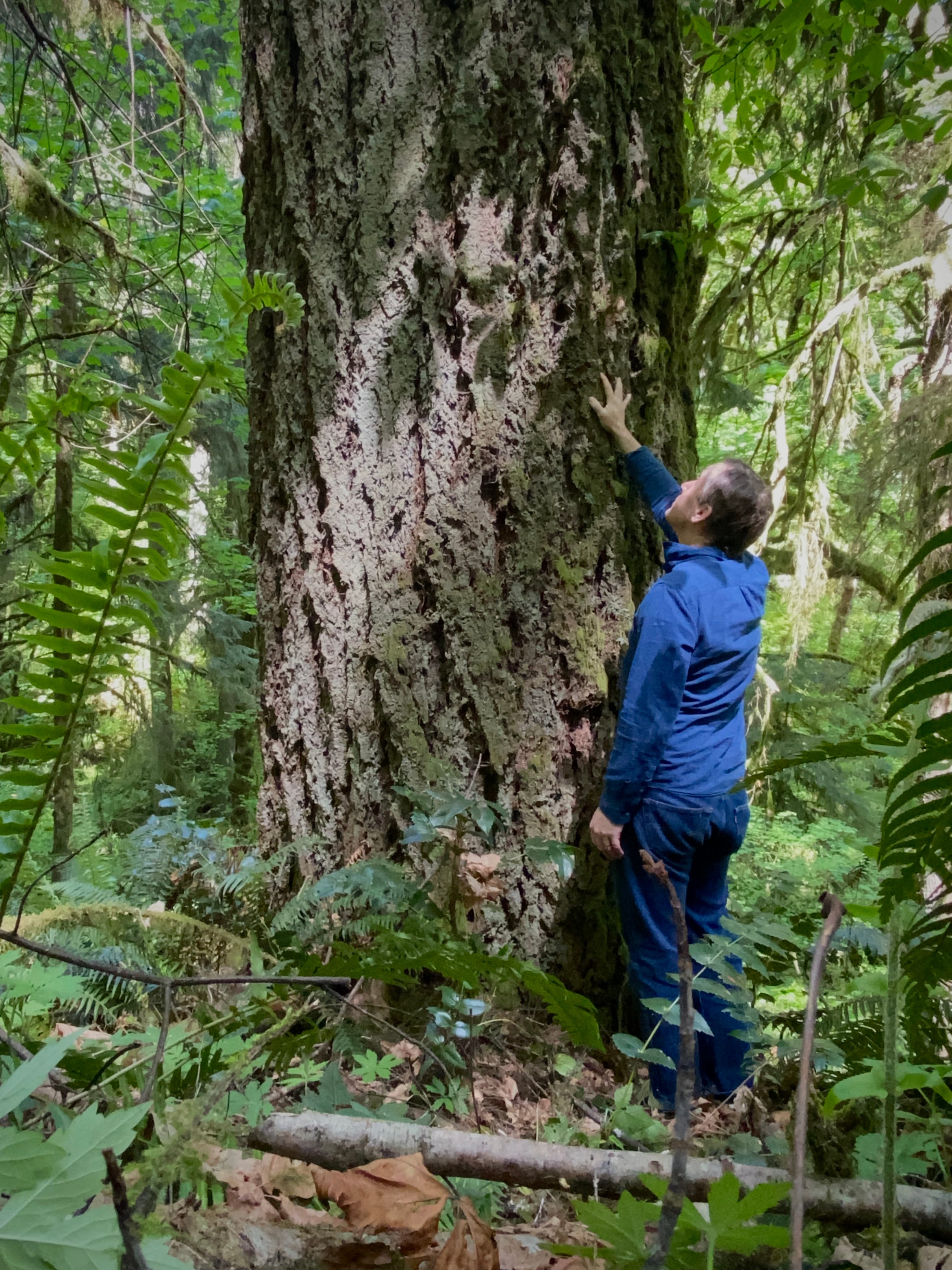
When I walked back up to the road and away from the tree to pinpoint its top, the result was computed to be 278 feet, which if true, would be the new tallest tree in Portland!

However, it’s likely it was an inaccurate measurement (and is not corroborated by the LiDAR data as far as I can tell) but still it was a thrill just to gaze in wonder at the number. Out of a field of six hundred trees over 200 feet tall in the park, there’s bound to be one that is closing in on, or has already silently surpassed the reigning 268 feet. tall champ, just a few miles to the south.
Despite the mountains of data we humans generate, compile and compute, there are still many things that remain unquantified, and unknown. Maybe it’s better that way.
This quest arose from my research into Forest Park and the Wildwood Trail. I decided that the 10-part series wasn’t general interest enough to justify weekly newsletter sends, so many of the last dispatches are being published straight-to-blog as a reference collection. The latest one gives context, both narratively and geographically, for this post:

Lastly, this Forest Park series is a related project to my first vinyl LP release, Wildwood Trail Soundwalk. It’s a thing of beauty, officially landing June 26. Check it out!
Thanks for reading and listening!